在這個資料中,我們有兩種細菌。前面的46個觀察值是CRE,後面的49個則不是。
我們希望將資料分類為是否為 CRE。Peak是蛋白質的名稱,而P_value是各蛋白質的重要程度,較低的p_value意味著對是否為CRE的影響更大。因此, 我們將選取較低的p_value變數來構建分類器。
資料是水平資料。因此我們先將資料轉置成一個95個觀測值與1471個變數的格式,標記何者為CRE, 然後使用機器學習方法對資料進行分類。最後,使用Leave-One-Out交叉驗證來比較各方法的測試精準度。
In this data, we have two types bacteria. The front 46 observers are CRE and back 49s are non-CRE.
We want to classificate the data to CRE or not. The p_value is the index of Peak(Protein types). Lower p_value means more influence for CREs. So we will pick lower p_value variables to build classificators.
The data is a horizontal data. So we will transpose the data become a size of 95 observations of 1471 variables at begining. Label the CREs ,then use machine learning methods to classificate data. Finally using the Leave-One-Out Cross Validation to compare methods’ test-accuracies.
Data processing
Read data
data_csv <- read.csv("C:\\Users\\User\\OneDrive - student.nsysu.edu.tw\\Educations\\NSYSU\\fu_chung\\bacterial\\20180111_CRE_46-non-CRE_49_Intensity.csv")

#preview the origin data
head(data_csv[,1:5],10)
## Peak p.value q.value B1050328.154.CRE.KP B1050603.077.CRE.KP
## 1 1998.333 0.02145536 0.37130388 0 0.00
## 2 2007.091 0.58751830 1.00000000 0 0.00
## 3 2012.881 0.23143251 0.87068344 0 11222.02
## 4 2030.663 0.60917531 1.00000000 0 0.00
## 5 2036.960 1.00000000 1.00000000 0 0.00
## 6 2059.762 1.00000000 1.00000000 0 0.00
## 7 2090.549 0.67573691 1.00000000 0 135239.75
## 8 2094.218 1.00000000 1.00000000 0 0.00
## 9 2107.575 0.00045300 0.06658398 0 0.00
## 10 2124.102 0.76943375 1.00000000 0 0.00可看出兩種類別的數量非常接近,CRE為46個,非CRE為49個。
arrange
將資料轉置成我們要的方向,因為原資料的peak有1471種,其重要性以p value的大小為分別,這裡我只取前50小(顯著)的種類,並且因為前面的46個觀察值是CRE,後面的49個則不是,因此在這裡幫前46比觀察值加入label,讓後續的分類可以更好進行。因此最終資料將呈現95比觀察值與51個變數(前50 peak 的解釋變數以及一個CRE類別反應變數)。
if (!require(tidyverse)) install.packages('tidyverse')## Loading required package: tidyverse## -- Attaching packages ----------------------------------------------------------------------------------------------- tidyverse 1.2.1 --## √ ggplot2 3.1.1 √ purrr 0.3.2
## √ tibble 2.1.1 √ dplyr 0.8.0.1
## √ tidyr 0.8.3 √ stringr 1.4.0
## √ readr 1.3.1 √ forcats 0.4.0## -- Conflicts -------------------------------------------------------------------------------------------------- tidyverse_conflicts() --
## x dplyr::filter() masks stats::filter()
## x dplyr::lag() masks stats::lag()library(tidyverse)
#sort data by p.value
data_csv <- arrange(data_csv,p.value)
#transpose data
name_protein <- data_csv[,1]
data <- as.data.frame(t(data_csv))
data <- data[-c(1:3),]
#remain 50 variables who have the lower p.value
name_variable <- names(data)
data <- data[,c(1:50)]
#data name
data_name <- data.frame(name_variable,name_protein)
data_name <- as.data.frame(t(data_name))
head(data_name[1:5])## V1 V2 V3 V4 V5
## name_variable V1 V2 V3 V4 V5
## name_protein 2636.880 3830.576 4447.421 3317.308 7401.614#label CRE as factor
data$CRE <- as.factor(c(rep(1,46),rep(0,49)))
#preview front of 5 variables and CRE.
head(data[,c(1:5,51)],10)## V1 V2 V3 V4 V5 CRE
## B1050328.154.CRE.KP 251357.7 0.00 494285.5 114879.4 31439.26 1
## B1050603.077.CRE.KP 394550.2 65408.65 2186094.8 137296.9 0.00 1
## B1050723.021.CRE.KP 0.0 129236.21 675608.8 182865.2 16074.49 1
## B1050902.121.CRE.KP 137403.3 0.00 818021.2 0.0 0.00 1
## B1060202.094.CRE.KP 377358.8 327564.66 532502.6 0.0 0.00 1
## B1060217.087.CRE.KP 321700.3 300239.31 220649.5 289622.5 42589.68 1
## B1060311.004.CRE.KP 122302.3 163517.28 143966.8 197686.0 44586.54 1
## B1060429.067.CRE.KP 458382.1 136389.20 412460.2 294669.0 46850.84 1
## B1060522.013.CRE.KP 404748.2 97165.77 800137.4 134355.1 0.00 1
## B1060606.077.CRE.KP 0.0 237456.30 489450.3 317787.7 0.00 1#Plot the CRE type
plot(data$CRE)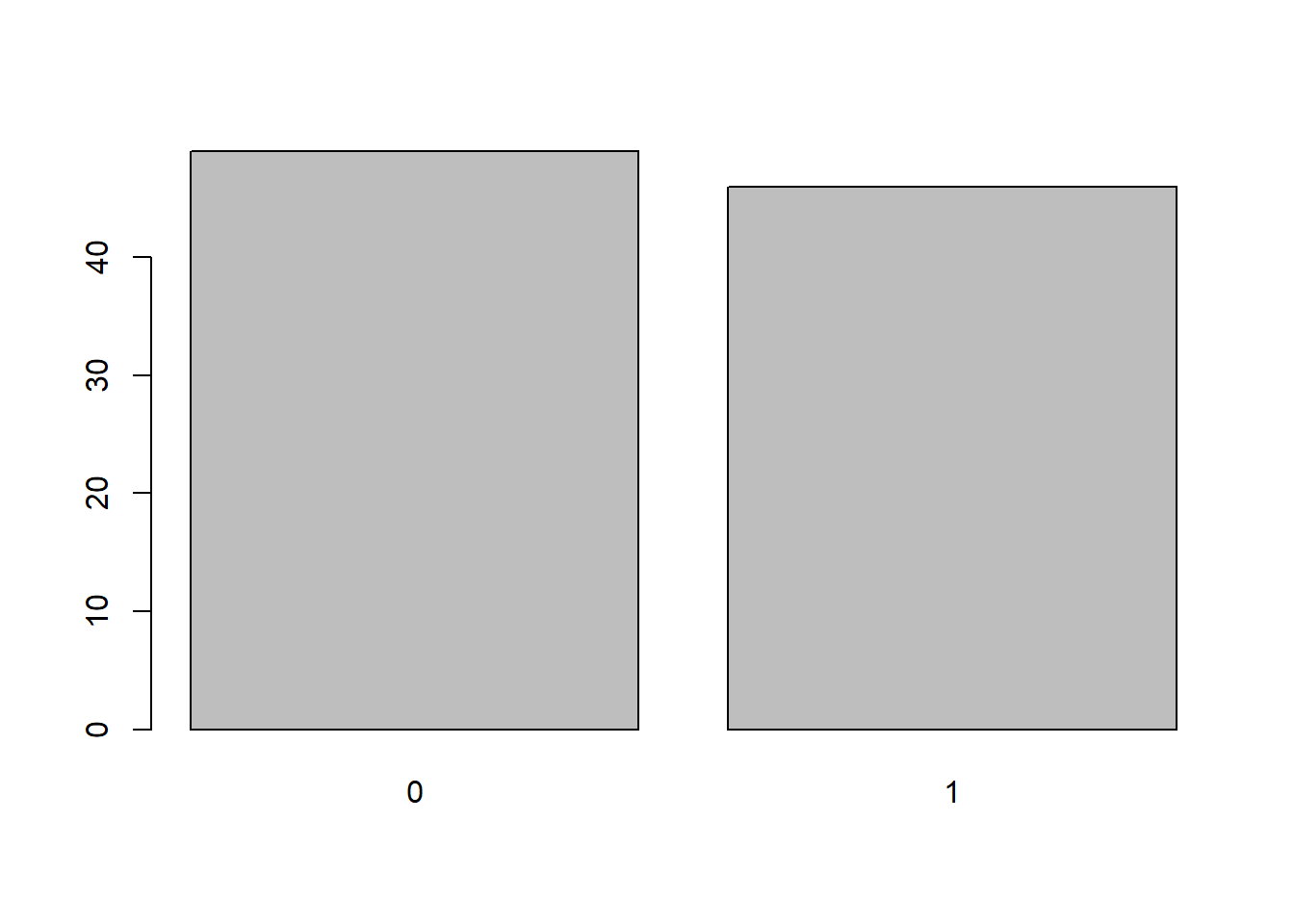
Bulid the Classificators
Support vector machine
if (!require(e1071)) install.packages('e1071')## Loading required package: e1071library(e1071)
svm_loocv_accuracy <- vector()
for(i in c(1:95)){
train = data[-i, ]
test = data[i, ]
svm_model = svm(formula = CRE ~ .,
data = train)
test.pred = predict(svm_model, test)
#Accuracy
confus.matrix = table(real=test$CRE, predict=test.pred)
svm_loocv_accuracy[i]=sum(diag(confus.matrix))/sum(confus.matrix)
}
#LOOCV test accuracy
mean(svm_loocv_accuracy) # Accurary with LOOCV = 0.8526316## [1] 0.8526316Random Forest
if (!require(randomForest)) install.packages('randomForest')## Loading required package: randomForest## randomForest 4.6-14## Type rfNews() to see new features/changes/bug fixes.##
## Attaching package: 'randomForest'## The following object is masked from 'package:dplyr':
##
## combine## The following object is masked from 'package:ggplot2':
##
## marginlibrary(randomForest)
rf_loocv_accuracy <- vector()
for(i in c(1:95)){
train = data[-i, ]
test = data[i, ]
rf_model = randomForest(CRE~.,
data=train,
ntree=150 # num of decision Tree
)
test.pred = predict(rf_model, test)
#Accuracy
confus.matrix = table(real=test$CRE, predict=test.pred)
rf_loocv_accuracy[i]=sum(diag(confus.matrix))/sum(confus.matrix)
}
#LOOCV test accuracy
mean(rf_loocv_accuracy) # Accurary with LOOCV = 0.9157895## [1] 0.8947368KNN with distance = 10
if (!require(kknn))install.packages("kknn")## Loading required package: kknnlibrary(kknn)
knn_loocv_accuracy <- vector()
for(i in c(1:95)){
train = data[-i, ]
test = data[i, ]
knn_model <- kknn(CRE~., train, test, distance = 10) # knn distance = 10
fit <- fitted(knn_model)
#Accuracy
confus.matrix = table(real=test$CRE, predict=test.pred)
knn_loocv_accuracy[i]=sum(diag(confus.matrix))/sum(confus.matrix)
}
#LOOCV test accuracy
mean(knn_loocv_accuracy) # Accurary with LOOCV = 0.5157895## [1] 0.5157895Naïve Bayes
if (!require(e1071))install.packages("e1071")
library(e1071)

nb_loocv_accuracy <- vector()
nb_loocv_mse <- vector()

for(i in c(1:95)){
  train = data[-i, ]
  test  = data[i, ]

  nb_model=naiveBayes(CRE~., data=train)

  test.pred = predict(nb_model, test)

  #Accuracy
  confus.matrix = table(test$CRE, test.pred)
  nb_loocv_accuracy[i] <- sum(diag(confus.matrix))/sum(confus.matrix)
}

#LOOCV test accuracy
mean(nb_loocv_accuracy) # Accurary with LOOCV = 0.6947368
## [1] 0.6947368Logistic Regression
lr_loocv_accuracy <- vector()
for(i in c(1:95)){
  train = data[-i, ]
  test  = data[i, ]

  lr_model<-glm(formula=CRE~.,data=train, family=binomial(link="logit"),na.action=na.exclude)

  test.pred = predict(lr_model, test)

  #Accuracy
  confus.matrix = table(test$CRE, test.pred)
  lr_loocv_accuracy[i] <- sum(diag(confus.matrix))/sum(confus.matrix)
}

#LOOCV test accuracy
mean(lr_loocv_accuracy) # Accurary with LOOCV = 0.5157895
## [1] 0.5157895The LOOCV Accuracy rank for this data is :
1. “Random Forest(0.9157895)”
2. “Support vector machine(0.8526316)”
3. “Naïve Bayes(0.6947368)”
4. “Logistic Regression(0.5157895)”
4. “KNN = 10 (0.5157895)”