這次我使用sklearn內建的資料集breast-cancer(原始資料來源:https://archive.ics.uci.edu/ml/datasets/Breast+Cancer+Wisconsin+(Diagnostic)) ,先將原資料以7:3比例建立一個的資料分類器出來,之後把其中一個類別挑出,並使用各種oversampling的方法來模擬樣本,並最終將模擬後的資料套回最初的模型當中,比較各方法產生的樣本能否在分類器當中回到原本的類別當中。
1. 讀入資料
讀取sklearn的資料並轉為dataframe:
import pandas as pd
import numpy as np
from sklearn import datasets

# import some data to play with
df = datasets.load_breast_cancer()
x = pd.DataFrame(df['data'],columns = df['feature_names'])
y = pd.DataFrame(df['target'],columns = ['targets_names'])
稍微檢查一下資料的型態與內容:
print(x.shape)
x.head()
(569, 30)| mean radius | mean texture | mean perimeter | mean area | mean smoothness | mean compactness | mean concavity | mean concave points | mean symmetry | mean fractal dimension | … | worst radius | worst texture | worst perimeter | worst area | worst smoothness | worst compactness | worst concavity | worst concave points | worst symmetry | worst fractal dimension | |
|---|---|---|---|---|---|---|---|---|---|---|---|---|---|---|---|---|---|---|---|---|---|
| 0 | 17.99 | 10.38 | 122.80 | 1001.0 | 0.11840 | 0.27760 | 0.3001 | 0.14710 | 0.2419 | 0.07871 | … | 25.38 | 17.33 | 184.60 | 2019.0 | 0.1622 | 0.6656 | 0.7119 | 0.2654 | 0.4601 | 0.11890 |
| 1 | 20.57 | 17.77 | 132.90 | 1326.0 | 0.08474 | 0.07864 | 0.0869 | 0.07017 | 0.1812 | 0.05667 | … | 24.99 | 23.41 | 158.80 | 1956.0 | 0.1238 | 0.1866 | 0.2416 | 0.1860 | 0.2750 | 0.08902 |
| 2 | 19.69 | 21.25 | 130.00 | 1203.0 | 0.10960 | 0.15990 | 0.1974 | 0.12790 | 0.2069 | 0.05999 | … | 23.57 | 25.53 | 152.50 | 1709.0 | 0.1444 | 0.4245 | 0.4504 | 0.2430 | 0.3613 | 0.08758 |
| 3 | 11.42 | 20.38 | 77.58 | 386.1 | 0.14250 | 0.28390 | 0.2414 | 0.10520 | 0.2597 | 0.09744 | … | 14.91 | 26.50 | 98.87 | 567.7 | 0.2098 | 0.8663 | 0.6869 | 0.2575 | 0.6638 | 0.17300 |
| 4 | 20.29 | 14.34 | 135.10 | 1297.0 | 0.10030 | 0.13280 | 0.1980 | 0.10430 | 0.1809 | 0.05883 | … | 22.54 | 16.67 | 152.20 | 1575.0 | 0.1374 | 0.2050 | 0.4000 | 0.1625 | 0.2364 | 0.07678 |
5 rows × 30 columns
y.head()| targets_names | |
|---|---|
| 0 | 0 |
| 1 | 0 |
| 2 | 0 |
| 3 | 0 |
| 4 | 0 |
%matplotlib inline
by_fraud = y.groupby('targets_names')
by_fraud.size().plot(kind = 'bar')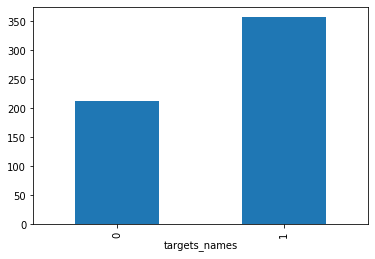
2. 建構分類器
這次使用adaboost來建立分類器,其準確率大約為0.99-0.95之間。
from sklearn.model_selection import train_test_split
from sklearn.ensemble import AdaBoostClassifier
from sklearn import ensemble
from sklearn import metrics
import random

random.seed(1)
arr = np.arange(569)
np.random.shuffle(arr)


train_X = x.iloc[arr[0:398],:]
test_X = x.iloc[arr[398:569],:]
train_y = y.iloc[arr[0:398],:]
test_y = y.iloc[arr[398:569],:]

clf = AdaBoostClassifier(n_estimators=100)
#forest = ensemble.RandomForestClassifier(n_estimators = 100)
fit = clf.fit(train_X, train_y)

test_y_predicted = clf.predict(test_X)
accuracy_rf = metrics.accuracy_score(test_y, test_y_predicted)
print(accuracy_rf)
C:3-gpu-packages.py:724: DataConversionWarning: A column-vector y was passed when a 1d array was expected. Please change the shape of y to (n_samples, ), for example using ravel(). y = column_or_1d(y, warn=True)
0.9941520467836257
3. 生成資料
將0類(較少類)資料切出,並使用ocwgan,ocgan,smote與adasyn等方法,在此先設定這些方法:
f_x = x[y['targets_names'].isin([0])]
f_y = y[y['targets_names'].isin([0])]
print(f_x.shape)
print(f_y.shape)
(212, 30) (212, 1)
f_x.head()| mean radius | mean texture | mean perimeter | mean area | mean smoothness | mean compactness | mean concavity | mean concave points | mean symmetry | mean fractal dimension | … | worst radius | worst texture | worst perimeter | worst area | worst smoothness | worst compactness | worst concavity | worst concave points | worst symmetry | worst fractal dimension | |
|---|---|---|---|---|---|---|---|---|---|---|---|---|---|---|---|---|---|---|---|---|---|
| 0 | 17.99 | 10.38 | 122.80 | 1001.0 | 0.11840 | 0.27760 | 0.3001 | 0.14710 | 0.2419 | 0.07871 | … | 25.38 | 17.33 | 184.60 | 2019.0 | 0.1622 | 0.6656 | 0.7119 | 0.2654 | 0.4601 | 0.11890 |
| 1 | 20.57 | 17.77 | 132.90 | 1326.0 | 0.08474 | 0.07864 | 0.0869 | 0.07017 | 0.1812 | 0.05667 | … | 24.99 | 23.41 | 158.80 | 1956.0 | 0.1238 | 0.1866 | 0.2416 | 0.1860 | 0.2750 | 0.08902 |
| 2 | 19.69 | 21.25 | 130.00 | 1203.0 | 0.10960 | 0.15990 | 0.1974 | 0.12790 | 0.2069 | 0.05999 | … | 23.57 | 25.53 | 152.50 | 1709.0 | 0.1444 | 0.4245 | 0.4504 | 0.2430 | 0.3613 | 0.08758 |
| 3 | 11.42 | 20.38 | 77.58 | 386.1 | 0.14250 | 0.28390 | 0.2414 | 0.10520 | 0.2597 | 0.09744 | … | 14.91 | 26.50 | 98.87 | 567.7 | 0.2098 | 0.8663 | 0.6869 | 0.2575 | 0.6638 | 0.17300 |
| 4 | 20.29 | 14.34 | 135.10 | 1297.0 | 0.10030 | 0.13280 | 0.1980 | 0.10430 | 0.1809 | 0.05883 | … | 22.54 | 16.67 | 152.20 | 1575.0 | 0.1374 | 0.2050 | 0.4000 | 0.1625 | 0.2364 | 0.07678 |
5 rows × 30 columns
3.1 OCWGAN setting
# import modules
%matplotlib inline
import os
import random
import keras
import numpy as np
import pandas as pd
import matplotlib.pyplot as plt
import seaborn as sns
from tqdm import tqdm_notebook as tqdm
from keras.models import Model
from keras.layers import Input, Reshape
from keras.layers.core import Dense, Activation, Dropout, Flatten
from keras.layers.normalization import BatchNormalization
from keras.layers.convolutional import UpSampling1D, Conv1D
from keras.layers.advanced_activations import LeakyReLU
from keras.optimizers import Adam, SGD,RMSprop
from keras.callbacks import TensorBoard
from sklearn.preprocessing import StandardScaler

# set parameters
dim = f_x.shape[1]
num = f_x.shape[0]
g_data = f_x

# Standard Scaler
ss = StandardScaler()
g_data = pd.DataFrame(ss.fit_transform(g_data))

# wasserstein_loss
from keras import backend
# implementation of wasserstein loss
def wasserstein_loss(y_true, y_pred):
    return backend.mean(y_true * y_pred)

# generator
def get_generative(G_in, dense_dim=200, out_dim= dim, lr=1e-3):
    x = Dense(dense_dim)(G_in)
    x = Activation('tanh')(x)
    G_out = Dense(out_dim, activation='tanh')(x)
    G = Model(G_in, G_out)
    opt = keras.optimizers.RMSprop(lr=lr)#原先為SGD
    G.compile(loss=wasserstein_loss, optimizer=opt)#原loss為binary_crossentropy
    return G, G_out

G_in = Input(shape=[10])
G, G_out = get_generative(G_in)
G.summary()

# discriminator
def get_discriminative(D_in, lr=1e-3, drate=.25, n_channels= dim, conv_sz=5, leak=.2):#lr=1e-3, drate=.25, n_channels= dim, conv_sz=5, leak=.2
    x = Reshape((-1, 1))(D_in)
    x = Conv1D(n_channels, conv_sz, activation='relu')(x)
    x = Dropout(drate)(x)
    x = Flatten()(x)
    x = Dense(n_channels)(x)
    D_out = Dense(2, activation='linear')(x)#sigmoid
    D = Model(D_in, D_out)
    dopt = keras.optimizers.RMSprop(lr=lr)#原先為Adam
    D.compile(loss=wasserstein_loss, optimizer=dopt)
    return D, D_out

D_in = Input(shape=[dim])
D, D_out = get_discriminative(D_in)
D.summary()

# set up gan
def set_trainability(model, trainable=False):
    model.trainable = trainable
    for layer in model.layers:
        layer.trainable = trainable

def make_gan(GAN_in, G, D):
    set_trainability(D, False)
    x = G(GAN_in)
    GAN_out = D(x)
    GAN = Model(GAN_in, GAN_out)
    GAN.compile(loss=wasserstein_loss, optimizer=G.optimizer)#元loss為binary_crossentropy
    return GAN, GAN_out

GAN_in = Input([10])
GAN, GAN_out = make_gan(GAN_in, G, D)
GAN.summary()

# pre train
def sample_data_and_gen(G, noise_dim=10, n_samples= num):
    XT = np.array(g_data)
    XN_noise = np.random.uniform(0, 1, size=[n_samples, noise_dim])
    XN = G.predict(XN_noise)
    X = np.concatenate((XT, XN))
    y = np.zeros((2*n_samples, 2))
    y[:n_samples, 1] = 1
    y[n_samples:, 0] = 1
    return X, y

def pretrain(G, D, noise_dim=10, n_samples = num, batch_size=32):
    X, y = sample_data_and_gen(G, n_samples=n_samples, noise_dim=noise_dim)
    set_trainability(D, True)
    D.fit(X, y, epochs=1, batch_size=batch_size)

pretrain(G, D)

def sample_noise(G, noise_dim=10, n_samples=num):
    X = np.random.uniform(0, 1, size=[n_samples, noise_dim])
    y = np.zeros((n_samples, 2))
    y[:, 1] = 1
    return X, y

# one class detector
def oneclass(data,kernel = 'rbf',gamma = 'auto'):
    num1 = int(len(data)/2)
    num2 = int(len(data)+1)
    from sklearn import svm
    clf = svm.OneClassSVM(kernel=kernel, gamma=gamma).fit(data[0:num1])
    origin = pd.DataFrame(clf.score_samples(data[0:num1]))
    new = pd.DataFrame(clf.score_samples(data[num1:num2]))

    occ = pd.concat([pd.DataFrame(new[0] < origin[0].min()),pd.DataFrame(new[0] > origin[0].max())], axis=1)
    occ['ava'] = pd.DataFrame(occ.iloc[:,1:2] == occ.iloc[:,0:1])
    err = sum(occ['ava'] == False)/len(occ['ava'])
    return err

# productor
def gen(GAN, G, D, times=50, n_samples= num, noise_dim=10, batch_size=32, verbose=False, v_freq=dim,):
    data = pd.DataFrame()
    for epoch in range(times):
        X, y = sample_data_and_gen(G, n_samples=n_samples, noise_dim=noise_dim)
        set_trainability(D, True)
        xx,yy = X,y
        err = oneclass(xx)
        num1 = int(len(xx)/2)
        num2 = int(len(xx)+1)
        xx = ss.inverse_transform(xx)
        data = pd.concat([data,pd.DataFrame(xx[num1:num2])],axis = 0)
        print("The %d times generator one class svm Error Rate=%f" %(epoch, err))

    return data

# training
def train(GAN, G, D, epochs=1, n_samples= num, noise_dim=10, batch_size=32, verbose=False, v_freq=dim,):
    d_loss = []
    g_loss = []
    e_range = range(epochs)
    if verbose:
        e_range = tqdm(e_range)
    for epoch in e_range:
        X, y = sample_data_and_gen(G, n_samples=n_samples, noise_dim=noise_dim)
        set_trainability(D, True)
        d_loss.append(D.train_on_batch(X, y))
        xx,yy = X,y
        err = oneclass(xx)
        print("The %d times epoch one class svm Error Rate=%f" %(epoch, err))

        X, y = sample_noise(G, n_samples=n_samples, noise_dim=noise_dim)
        set_trainability(D, False)
        g_loss.append(GAN.train_on_batch(X, y))
        if verbose and (epoch + 1) % v_freq == 0:
            print("Epoch #{}: Generative Loss: {}, Discriminative Loss: {}".format(epoch + 1, g_loss[-1], d_loss[-1]))

    return d_loss, g_loss, xx, yy
Layer (type) Output Shape Param #
=================================================================
input_25 (InputLayer) (None, 10) 0
_________________________________________________________________
dense_27 (Dense) (None, 200) 2200
_________________________________________________________________
activation_12 (Activation) (None, 200) 0
_________________________________________________________________
dense_28 (Dense) (None, 30) 6030
=================================================================
Total params: 8,230
Trainable params: 8,230
Non-trainable params: 0
_________________________________________________________________
_________________________________________________________________
Layer (type) Output Shape Param #
=================================================================
input_26 (InputLayer) (None, 30) 0
_________________________________________________________________
reshape_12 (Reshape) (None, 30, 1) 0
_________________________________________________________________
conv1d_12 (Conv1D) (None, 26, 30) 180
_________________________________________________________________
dropout_12 (Dropout) (None, 26, 30) 0
_________________________________________________________________
flatten_12 (Flatten) (None, 780) 0
_________________________________________________________________
dense_29 (Dense) (None, 30) 23430
_________________________________________________________________
dense_30 (Dense) (None, 2) 62
=================================================================
Total params: 23,672
Trainable params: 23,672
Non-trainable params: 0
_________________________________________________________________
_________________________________________________________________
Layer (type) Output Shape Param #
=================================================================
input_27 (InputLayer) (None, 10) 0
_________________________________________________________________
model_16 (Model) (None, 30) 8230
_________________________________________________________________
model_17 (Model) (None, 2) 23672
=================================================================
Total params: 31,902
Trainable params: 8,230
Non-trainable params: 23,672
_________________________________________________________________
Epoch 1/1
424/424 [==============================] - ETA: 5s - loss: 0.005 - 1s 1ms/step - loss: -1.6706
3.2 OCGAN setting
# import modules
%matplotlib inline
import os
import random
import numpy as np
import pandas as pd
import matplotlib.pyplot as plt
import seaborn as sns
from tqdm import tqdm_notebook as tqdm
from keras.models import Model
from keras.layers import Input, Reshape
from keras.layers.core import Dense, Activation, Dropout, Flatten
from keras.layers.normalization import BatchNormalization
from keras.layers.convolutional import UpSampling1D, Conv1D
from keras.layers.advanced_activations import LeakyReLU
from keras.optimizers import Adam, SGD
from keras.callbacks import TensorBoard
from sklearn.preprocessing import StandardScaler

# set parameters
dim = f_x.shape[1]
num = f_x.shape[0]
g_data = f_x

# Standard Scaler
ss = StandardScaler()
g_data = pd.DataFrame(ss.fit_transform(g_data))

# generator
def get_generative(G_in, dense_dim=200, out_dim= dim, lr=1e-3):
    x = Dense(dense_dim)(G_in)
    x = Activation('tanh')(x)
    G_out = Dense(out_dim, activation='tanh')(x)
    G = Model(G_in, G_out)
    opt = SGD(lr=lr)
    G.compile(loss='binary_crossentropy', optimizer=opt)
    return G, G_out

G_in = Input(shape=[10])
G, G_out = get_generative(G_in)
G.summary()

# discriminator
def get_discriminative(D_in, lr=1e-3, drate=.25, n_channels= dim, conv_sz=5, leak=.2):
    x = Reshape((-1, 1))(D_in)
    x = Conv1D(n_channels, conv_sz, activation='relu')(x)
    x = Dropout(drate)(x)
    x = Flatten()(x)
    x = Dense(n_channels)(x)
    D_out = Dense(2, activation='sigmoid')(x)
    D = Model(D_in, D_out)
    dopt = Adam(lr=lr)
    D.compile(loss='binary_crossentropy', optimizer=dopt)
    return D, D_out

D_in = Input(shape=[dim])
D, D_out = get_discriminative(D_in)
D.summary()

# set up gan
def set_trainability(model, trainable=False):
    model.trainable = trainable
    for layer in model.layers:
        layer.trainable = trainable

def make_gan(GAN_in, G, D):
    set_trainability(D, False)
    x = G(GAN_in)
    GAN_out = D(x)
    GAN = Model(GAN_in, GAN_out)
    GAN.compile(loss='binary_crossentropy', optimizer=G.optimizer)
    return GAN, GAN_out

GAN_in = Input([10])
GAN, GAN_out = make_gan(GAN_in, G, D)
GAN.summary()

# pre train
def sample_data_and_gen(G, noise_dim=10, n_samples= num):
    XT = np.array(g_data)
    XN_noise = np.random.uniform(0, 1, size=[n_samples, noise_dim])
    XN = G.predict(XN_noise)
    X = np.concatenate((XT, XN))
    y = np.zeros((2*n_samples, 2))
    y[:n_samples, 1] = 1
    y[n_samples:, 0] = 1
    return X, y

def pretrain(G, D, noise_dim=10, n_samples = num, batch_size=32):
    X, y = sample_data_and_gen(G, n_samples=n_samples, noise_dim=noise_dim)
    set_trainability(D, True)
    D.fit(X, y, epochs=1, batch_size=batch_size)

pretrain(G, D)

def sample_noise(G, noise_dim=10, n_samples=num):
    X = np.random.uniform(0, 1, size=[n_samples, noise_dim])
    y = np.zeros((n_samples, 2))
    y[:, 1] = 1
    return X, y

# one class detector
def oneclass(data,kernel = 'rbf',gamma = 'auto'):
    num1 = int(len(data)/2)
    num2 = int(len(data)+1)
    from sklearn import svm
    clf = svm.OneClassSVM(kernel=kernel, gamma=gamma).fit(data[0:num1])
    origin = pd.DataFrame(clf.score_samples(data[0:num1]))
    new = pd.DataFrame(clf.score_samples(data[num1:num2]))

    occ = pd.concat([pd.DataFrame(new[0] < origin[0].min()),pd.DataFrame(new[0] > origin[0].max())], axis=1)
    occ['ava'] = pd.DataFrame(occ.iloc[:,1:2] == occ.iloc[:,0:1])
    err = sum(occ['ava'] == False)/len(occ['ava'])
    return err

# training
def train1(GAN, G, D, epochs=1, n_samples= num, noise_dim=10, batch_size=32, verbose=False, v_freq=dim,):
    d_loss = []
    g_loss = []
    e_range = range(epochs)
    if verbose:
        e_range = tqdm(e_range)
    for epoch in e_range:
        X, y = sample_data_and_gen(G, n_samples=n_samples, noise_dim=noise_dim)
        set_trainability(D, True)
        d_loss.append(D.train_on_batch(X, y))
        xx,yy = X,y
        err = oneclass(xx)
        print("The %d times epoch one class svm Error Rate=%f" %(epoch, err))

        X, y = sample_noise(G, n_samples=n_samples, noise_dim=noise_dim)
        set_trainability(D, False)
        g_loss.append(GAN.train_on_batch(X, y))
        if verbose and (epoch + 1) % v_freq == 0:
            print("Epoch #{}: Generative Loss: {}, Discriminative Loss: {}".format(epoch + 1, g_loss[-1], d_loss[-1]))
    return d_loss, g_loss, xx, yy
Layer (type) Output Shape Param #
=================================================================
input_28 (InputLayer) (None, 10) 0
_________________________________________________________________
dense_31 (Dense) (None, 200) 2200
_________________________________________________________________
activation_13 (Activation) (None, 200) 0
_________________________________________________________________
dense_32 (Dense) (None, 30) 6030
=================================================================
Total params: 8,230
Trainable params: 8,230
Non-trainable params: 0
_________________________________________________________________
_________________________________________________________________
Layer (type) Output Shape Param #
=================================================================
input_29 (InputLayer) (None, 30) 0
_________________________________________________________________
reshape_13 (Reshape) (None, 30, 1) 0
_________________________________________________________________
conv1d_13 (Conv1D) (None, 26, 30) 180
_________________________________________________________________
dropout_13 (Dropout) (None, 26, 30) 0
_________________________________________________________________
flatten_13 (Flatten) (None, 780) 0
_________________________________________________________________
dense_33 (Dense) (None, 30) 23430
_________________________________________________________________
dense_34 (Dense) (None, 2) 62
=================================================================
Total params: 23,672
Trainable params: 23,672
Non-trainable params: 0
_________________________________________________________________
_________________________________________________________________
Layer (type) Output Shape Param #
=================================================================
input_30 (InputLayer) (None, 10) 0
_________________________________________________________________
model_19 (Model) (None, 30) 8230
_________________________________________________________________
model_20 (Model) (None, 2) 23672
=================================================================
Total params: 31,902
Trainable params: 8,230
Non-trainable params: 23,672
_________________________________________________________________
Epoch 1/1
424/424 [==============================] - ETA: 9s - loss: 0.726 - 1s 2ms/step - loss: 0.5255
3.3 SMOTE setting
from imblearn.over_sampling import SMOTE
smo = SMOTE()
X_smo, y_smo = smo.fit_sample(x, y)
X_smo = pd.DataFrame(X_smo)
y_smo = pd.DataFrame(y_smo)
C:3-gpu-packages.py:724: DataConversionWarning: A column-vector y was passed when a 1d array was expected. Please change the shape of y to (n_samples, ), for example using ravel(). y = column_or_1d(y, warn=True)
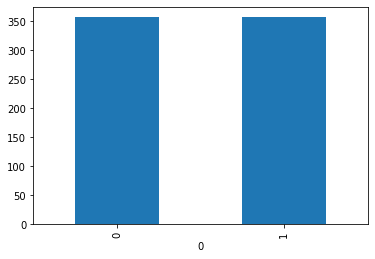
%matplotlib inline
by_fraud = y_smo.groupby(0)
by_fraud.size().plot(kind = 'bar')
<matplotlib.axes._subplots.AxesSubplot at 0x27f27709dd8>
3. 4 ADASYN setting
from imblearn.over_sampling import ADASYN
ada = ADASYN()
X_ada, y_ada = ada.fit_sample(x, y)
X_ada = pd.DataFrame(X_ada)
y_ada = pd.DataFrame(y_ada)
C:3-gpu-packages.py:724: DataConversionWarning: A column-vector y was passed when a 1d array was expected. Please change the shape of y to (n_samples, ), for example using ravel(). y = column_or_1d(y, warn=True)
4. 比較效果
我們將生成後的資料丟入之前建立的分類器當中,並希望其落於’0’類別,我會計算出現1的比例,比例越低代表越好,以下是個方法結果:
4.1 OCWGAN
我將不同的one class svm Error Rate做分類,欲比較其差異的效果。 ### ocwgan epoch 1
d_loss, g_loss ,xx,yy= train(GAN, G, D, epochs=1, verbose=True)
new_data = gen(GAN, G, D, times = 1,verbose=True)
test_y_predicted = clf.predict(new_data)
print(test_y_predicted,'error = ',np.mean(test_y_predicted))
The 0 times epoch one class svm Error Rate=1.000000
The 0 times generator one class svm Error Rate=0.896226
[0 0 0 0 0 0 0 0 0 0 0 0 0 0 0 0 0 0 0 0 0 0 0 0 0 0 0 0 0 0 0 0 0 0 0 0 0
0 0 0 0 0 0 0 0 0 0 0 0 0 0 0 0 0 0 0 0 0 0 0 0 0 0 0 0 0 0 0 0 0 0 0 0 0
0 0 0 0 0 0 0 0 0 0 0 0 0 0 0 0 0 0 0 0 0 0 0 0 0 0 0 0 0 0 0 0 0 0 0 0 0
0 0 0 0 0 0 0 0 0 0 0 0 0 0 0 0 0 0 0 0 0 0 0 0 0 0 0 0 0 0 0 0 0 0 0 0 0
0 0 0 0 0 0 0 0 0 0 0 0 0 0 0 0 0 0 0 0 0 0 0 0 0 0 0 0 0 0 0 0 0 0 0 0 0
0 0 0 0 0 0 0 0 0 0 0 0 0 0 0 0 0 0 0 0 0 0 0 0 0 0 0]
error = 0.0
ocwgan epoch 2
d_loss, g_loss ,xx,yy= train(GAN, G, D, epochs=1, verbose=True)
new_data = gen(GAN, G, D, times = 1,verbose=True)
test_y_predicted = clf.predict(new_data)
test_y_predicted
print(test_y_predicted,'error = ',np.mean(test_y_predicted))
The 0 times epoch one class svm Error Rate=0.853774
The 0 times generator one class svm Error Rate=0.240566
[0 0 0 0 0 0 0 0 0 0 0 0 0 0 0 0 0 0 0 0 0 0 0 0 0 0 0 0 0 0 0 0 0 0 0 0 0
0 0 0 0 0 0 0 0 0 0 0 0 0 0 0 0 0 0 0 0 0 0 0 0 0 0 0 0 0 0 0 0 0 0 0 0 0
0 0 0 0 0 0 0 0 0 0 0 0 0 0 0 0 0 0 0 0 0 0 0 0 0 0 0 0 0 0 0 0 0 0 0 0 0
0 0 0 0 0 0 0 0 0 0 0 0 0 0 0 0 0 0 0 0 0 0 0 0 0 0 0 0 0 0 0 0 0 0 0 0 0
0 0 0 0 0 0 0 0 0 0 0 0 0 0 0 0 0 0 0 0 0 0 0 0 0 0 0 0 0 0 0 0 0 0 0 0 0
0 0 0 0 0 0 0 0 0 0 0 0 0 0 0 0 0 0 0 0 0 0 0 0 0 0 0]
error = 0.0
ocwgan epoch 3
d_loss, g_loss ,xx,yy= train(GAN, G, D, epochs=1, verbose=True)
new_data = gen(GAN, G, D, times = 1,verbose=True)
test_y_predicted = clf.predict(new_data)
print(test_y_predicted,'error = ',np.mean(test_y_predicted))
HBox(children=(IntProgress(value=0, max=1), HTML(value=’’)))
The 0 times epoch one class svm Error Rate=0.188679
The 0 times generator one class svm Error Rate=0.070755
[0 0 0 0 0 0 0 0 0 0 0 0 0 0 0 0 0 0 0 0 0 0 0 0 0 0 0 0 0 0 0 0 0 0 0 0 0
0 0 0 0 0 0 0 0 0 0 0 0 0 0 0 0 0 0 0 0 0 0 0 0 0 0 0 0 0 0 0 0 0 0 0 0 0
0 0 0 0 0 0 0 0 0 0 0 0 0 0 0 0 0 0 0 0 0 0 0 0 0 0 0 0 0 0 0 0 0 0 0 0 0
0 0 0 0 0 0 0 0 0 0 0 0 0 0 0 0 0 0 0 0 0 0 0 0 0 0 0 0 0 0 0 0 0 0 0 0 0
0 0 0 0 0 0 0 0 0 0 0 0 0 0 0 0 0 0 0 0 0 0 0 0 0 0 0 0 0 0 0 0 0 0 0 0 0
0 0 0 0 0 0 0 0 0 0 0 0 0 0 0 0 0 0 0 0 0 0 0 0 0 0 0]
error = 0.0
ocwgan epoch 4
d_loss, g_loss ,xx,yy= train(GAN, G, D, epochs=1, verbose=True)
new_data = gen(GAN, G, D, times = 1,verbose=True)
test_y_predicted = clf.predict(new_data)
print(test_y_predicted,'error = ',np.mean(test_y_predicted))
HBox(children=(IntProgress(value=0, max=1), HTML(value=’’)))
The 0 times epoch one class svm Error Rate=0.042453
The 0 times generator one class svm Error Rate=0.014151
[0 0 0 0 0 0 0 0 0 0 0 0 0 0 0 0 0 0 0 0 0 0 0 0 0 0 0 0 0 0 0 0 0 0 0 0 0
0 0 0 0 0 0 0 0 0 0 0 0 0 0 0 0 0 0 0 0 0 0 0 0 0 0 0 0 0 0 0 0 0 0 0 0 0
0 0 0 0 0 0 0 0 0 0 0 0 0 0 0 0 0 0 0 0 0 0 0 0 0 0 0 0 0 0 0 0 0 0 0 0 0
0 0 0 0 0 0 0 0 0 0 0 0 0 0 0 0 0 0 0 0 0 0 0 0 0 0 0 0 0 0 0 0 0 0 0 0 0
0 0 0 0 0 0 0 0 0 0 0 0 0 0 0 0 0 0 0 0 0 0 0 0 0 0 0 0 0 0 0 0 0 0 0 0 0
0 0 0 0 0 0 0 0 0 0 0 0 0 0 0 0 0 0 0 0 0 0 0 0 0 0 0]
error = 0.0
ocwgan epoch 5
d_loss, g_loss ,xx,yy= train(GAN, G, D, epochs=1, verbose=True)
new_data = gen(GAN, G, D, times = 1,verbose=True)
test_y_predicted = clf.predict(new_data)
print(test_y_predicted,'error = ',np.mean(test_y_predicted))
HBox(children=(IntProgress(value=0, max=1), HTML(value=’’)))
The 0 times epoch one class svm Error Rate=0.009434
The 0 times generator one class svm Error Rate=0.000000
[0 0 0 0 0 0 0 0 0 0 0 0 0 0 0 0 0 0 0 0 0 0 0 0 0 0 0 0 0 0 0 0 0 0 0 0 0
0 0 0 0 0 0 0 0 0 0 0 0 0 0 0 0 0 0 0 0 0 0 0 0 0 0 0 0 0 0 0 0 0 0 0 0 0
0 0 0 0 0 0 0 0 0 0 0 0 0 0 0 0 0 0 0 0 0 0 0 0 0 0 0 0 0 0 0 0 0 0 0 0 0
0 0 0 0 0 0 0 0 0 0 0 0 0 0 0 0 0 0 0 0 0 0 0 0 0 0 0 0 0 0 0 0 0 0 0 0 0
0 0 0 0 0 0 0 0 0 0 0 0 0 0 0 0 0 0 0 0 0 0 0 0 0 0 0 0 0 0 0 0 0 0 0 0 0
0 0 0 0 0 0 0 0 0 0 0 0 0 0 0 0 0 0 0 0 0 0 0 0 0 0 0]
error = 0.0
ocwgan epoch 6
d_loss, g_loss ,xx,yy= train(GAN, G, D, epochs=1, verbose=True)
new_data = gen(GAN, G, D, times = 1,verbose=True)
test_y_predicted = clf.predict(new_data)
print(test_y_predicted,'error = ',np.mean(test_y_predicted))
HBox(children=(IntProgress(value=0, max=1), HTML(value=’’)))
The 0 times epoch one class svm Error Rate=0.000000
The 0 times generator one class svm Error Rate=0.000000
[0 0 0 0 0 0 0 0 0 0 0 0 0 0 0 0 0 0 0 0 0 0 0 0 0 0 0 0 0 0 0 0 0 0 0 0 0
0 0 0 0 0 0 0 0 0 0 0 0 0 0 0 0 0 0 0 0 0 0 0 0 0 0 0 0 0 0 0 0 0 0 0 0 0
0 0 0 0 0 0 0 0 0 0 0 0 0 0 0 0 0 0 0 0 0 0 0 0 0 0 0 0 0 0 0 0 0 0 0 0 0
0 0 0 0 0 0 0 0 0 0 0 0 0 0 0 0 0 0 0 0 0 0 0 0 0 0 0 0 0 0 0 0 0 0 0 0 0
0 0 0 0 0 0 0 0 0 0 0 0 0 0 0 0 0 0 0 0 0 0 0 0 0 0 0 0 0 0 0 0 0 0 0 0 0
0 0 0 0 0 0 0 0 0 0 0 0 0 0 0 0 0 0 0 0 0 0 0 0 0 0 0]
error = 0.0
4.2 OCGAN
我將不同的one class svm Error Rate做分類,欲比較其差異的效果。 ### ocgan epoch 1
d_loss, g_loss ,xx,yy= train1(GAN, G, D, epochs=1, verbose=True)
new_data = gen(GAN, G, D, times = 1,verbose=True)
test_y_predicted = clf.predict(new_data)
print(test_y_predicted,'error = ',np.mean(test_y_predicted))
HBox(children=(IntProgress(value=0, max=1), HTML(value=’’)))
The 0 times epoch one class svm Error Rate=1.000000
The 0 times generator one class svm Error Rate=1.000000
[0 0 0 0 0 0 0 0 0 0 0 0 0 0 0 0 0 0 0 0 0 0 0 0 0 0 0 0 0 0 0 0 0 0 0 0 0
0 0 0 0 0 0 0 0 0 0 0 0 0 0 0 0 0 0 0 0 0 0 0 0 0 0 0 0 0 0 0 0 0 0 0 0 0
0 0 0 0 0 0 0 0 0 0 0 0 0 0 0 0 0 0 0 0 0 0 0 0 0 0 0 0 0 0 0 0 0 0 0 0 0
0 0 0 0 0 0 0 0 0 0 0 0 0 0 0 0 0 0 0 0 0 0 0 0 0 0 0 0 0 0 0 0 0 0 0 0 0
0 0 0 0 0 0 0 0 0 0 0 0 0 0 0 0 0 0 0 0 0 0 0 0 0 0 0 0 0 0 0 0 0 0 0 0 0
0 0 0 0 0 0 0 0 0 0 0 0 0 0 0 0 0 0 0 0 0 0 0 0 0 0 0]
error = 0.0
ocgan epoch 2
d_loss, g_loss ,xx,yy= train1(GAN, G, D, epochs=100, verbose=True)
new_data = gen(GAN, G, D, times = 1,verbose=True)
test_y_predicted = clf.predict(new_data)
print(test_y_predicted,'error = ',np.mean(test_y_predicted))
The 0 times epoch one class svm Error Rate=1.000000
The 1 times epoch one class svm Error Rate=1.000000
The 2 times epoch one class svm Error Rate=1.000000
The 3 times epoch one class svm Error Rate=1.000000
…
The 30 times epoch one class svm Error Rate=1.000000
…
The 60 times epoch one class svm Error Rate=1.000000
…
The 90 times epoch one class svm Error Rate=0.905660
….
The 99 times epoch one class svm Error Rate=0.603774
The 0 times generator one class svm Error Rate=0.599057
[0 0 0 0 0 0 0 0 0 0 0 0 0 0 0 0 0 0 0 0 0 0 0 0 0 0 0 0 0 0 0 0 0 0 0 0 0
0 0 0 0 0 0 0 0 0 0 0 0 0 0 0 0 0 0 0 0 0 0 0 0 0 0 0 0 0 0 0 0 0 0 0 0 0
0 0 0 0 0 0 0 0 0 0 0 0 0 0 0 0 0 0 0 0 0 0 0 0 0 0 0 0 0 0 0 0 0 0 0 0 0
0 0 0 0 0 0 0 0 0 0 0 0 0 0 0 0 0 0 0 0 0 0 0 0 0 0 0 0 0 0 0 0 0 0 0 0 0
0 0 0 0 0 0 0 0 0 0 0 0 0 0 0 0 0 0 0 0 0 0 0 0 0 0 0 0 0 0 0 0 0 0 0 0 0
0 0 0 0 0 0 0 0 0 0 0 0 0 0 0 0 0 0 0 0 0 0 0 0 0 0 0]
error = 0.0
ocgan epoch 3
d_loss, g_loss ,xx,yy= train1(GAN, G, D, epochs=100, verbose=True)
new_data = gen(GAN, G, D, times = 1,verbose=True)
test_y_predicted = clf.predict(new_data)
print(test_y_predicted,'error = ',np.mean(test_y_predicted))
The 0 times epoch one class svm Error Rate=0.570755
The 1 times epoch one class svm Error Rate=0.603774
The 2 times epoch one class svm Error Rate=0.462264
The 3 times epoch one class svm Error Rate=0.457547
…
The 30 times epoch one class svm Error Rate=0.009434
…
The 60 times epoch one class svm Error Rate=0.004717
…
The 90 times epoch one class svm Error Rate=0.004717
The 99 times epoch one class svm Error Rate=0.000000
The 0 times generator one class svm Error Rate=0.000000
[0 0 0 0 0 0 0 0 0 0 0 0 0 0 0 0 0 0 0 0 0 0 0 0 0 0 0 0 0 0 0 0 0 0 0 0 0
0 0 0 0 0 0 0 0 0 0 0 0 0 0 0 0 0 0 0 0 0 0 0 0 0 0 0 0 0 0 0 0 0 0 0 0 0
0 0 0 0 0 0 0 0 0 0 0 0 0 0 0 0 0 0 0 0 0 0 0 0 0 0 0 0 0 0 0 0 0 0 0 0 0
0 0 0 0 0 0 0 0 0 0 0 0 0 0 0 0 0 0 0 0 0 0 0 0 0 0 0 0 0 0 0 0 0 0 0 0 0
0 0 0 0 0 0 0 0 0 0 0 0 0 0 0 0 0 0 0 0 0 0 0 0 0 0 0 0 0 0 0 0 0 0 0 0 0
0 0 0 0 0 0 0 0 0 0 0 0 0 0 0 0 0 0 0 0 0 0 0 0 0 0 0]
error = 0.0
4.3 SMOTE
new_data = X_smo.iloc[569:741,:]
test_y_predicted = clf.predict(new_data)
print(test_y_predicted)
print('error = ',np.mean(test_y_predicted))
[0 0 0 0 0 0 0 0 0 0 0 0 0 0 0 0 0 0 0 0 0 0 0 0 0 0 0 0 0 0 0 0 0 0 0 0 0
0 0 0 0 0 0 0 0 0 0 0 0 0 0 0 0 1 0 0 0 0 0 0 0 0 0 0 0 0 0 0 0 0 0 0 1 0
0 0 0 0 0 1 0 1 0 0 0 0 0 0 0 1 0 0 0 0 0 0 0 0 0 0 0 0 0 0 0 0 0 0 0 0 0
0 0 0 0 0 0 0 0 0 0 0 0 0 0 0 0 0 0 0 0 0 0 0 0 0 0 0 0 0 0 0 0 0 0]
error = 0.034482758620689655
4.4 ADASYN
new_data = X_ada.iloc[569:741,:]
test_y_predicted = clf.predict(new_data)
print(test_y_predicted)
print('error = ',np.mean(test_y_predicted))
[0 1 0 0 0 0 0 0 0 0 0 0 0 0 0 0 0 0 0 0 0 0 0 0 0 0 0 0 0 0 0 0 0 0 0 0 1
1 0 0 0 0 0 0 0 0 0 0 0 0 0 0 0 0 0 0 0 0 0 0 0 1 0 0 0 1 1 1 0 0 0 0 0 0
0 0 0 0 0 0 0 0 0 0 0 0 1 0 0 0 0 1 0 1 0 0 0 0 0 0 0 0 0 1 1 1 1 0 0 0 0
0 0 1 0 1 0 0 0 0 0 0 0 0 0 0 0 0 0 1 0 0 0 0 0 0 0 0 0 0 1 0 0 0 0 0]
error = 0.1232876712328767
5. 結論
以結果來看,gan的效果都是基本沒問題的,而ADASYN可能因其加入隨機偏移的關係導致資料更不符合原型態。另外很明顯one class svm Error Rate在wgan的收斂速度更快。